Bitcoin casinos for Australian players: why the whole market is offshore and what that costs you
 Available in US
Current as of 3 September 2026 — checked against ACMA, Curaçao GCB and Anjouan licensing registers.
There is no licensed online casino in Australia. That is the first sentence of this page because it is the first sentence of the market. The Interactive Gambling Act 2001 prohibits anyone from providing online casino games, online pokies, or in-play sports betting to a person in Australia. No state or territory issues a licence for it. The operators ranked below — every one of them — are offshore businesses that accept Australian players, hold a Curaçao or Anjouan licence, and operate outside the Australian consumer-protection system. A punter choosing one is trading away BetStop coverage, ACL recourse, and any local complaints body in exchange for a product the law does not offer at home. This page ranks ten of those operators, runs the bonus maths that the marketing avoids, and lays out what the trade-off actually looks like in 2026.
Table of Contents
- What a Bitcoin Casino Actually Is — and Why Australians Are Using Them
- The 10 Offshore Crypto Casinos Australians Actually Play At in 2026
- Why Your Bitcoin Casino Bonus Is Smaller Than the Headline Number
- The Bitcoin Pokies Where the RTP Actually Works in Your Favour
- What Crypto Casinos Do That Regular Online Casinos Can’t
- How Fast Your Bitcoin Withdrawal Really Arrives — and What Slows It Down
- Bitcoin Casino on Your Phone: What Mobile Play Looks Like in 2026
- Live Dealer Tables With Bitcoin: Blackjack, Roulette, and the Real Casino Feel
- The Legal Reality: Every Bitcoin Casino Australians Use Is Offshore
- Playing Safely: Where to Get Help When Gambling Stops Being Fun
- What Separates a Trusted Bitcoin Casino From Everything Else
- How We Evaluated Every Bitcoin Casino on This Page
- Before You Deposit a Single Satoshi: The Decision Every Australian Player Has to Make
- Frequently Asked Questions
What a Bitcoin Casino Actually Is — and Why Australians Are Using Them
A bitcoin casino is an online casino where Bitcoin is the deposit and withdrawal rail. Some are crypto-native — built around BTC and never touched a fiat payment processor — and some are fiat sites that bolted a crypto button onto the cashier. The two behave differently. A crypto-native platform settles deposits and withdrawals on a blockchain, keeps balances denominated in BTC, ETH or USDT, and lets the player move funds in and out without a bank. A hybrid platform does all the above plus PayID, cards or e-wallets, and converts crypto to AUD on deposit. The crypto-native model has been around since Cloudbet launched in 2013; the hybrid model is the more common shape on the market today.
Australians use them because the domestic alternative does not exist. The IGA 2001 prohibits the product; the credit-card and crypto payment ban from 11 June 2024 makes even wagering deposits harder to place; and the result is that a player who wants pokies, blackjack, roulette or live dealer action over the internet has to go offshore to get it. That is not a fringe market. The ACMA has directed Australian ISPs to block 1,564 illegal gambling and affiliate sites since November 2019, and more than 225 illegal services have withdrawn from the Australian market since 2017. The traffic exists because the legal product does not. This page covers the operators that survive that filter and reach Australian players in 2026. It does not cover the licensed AU wagering bookmakers (Sportsbet, bet365, Ladbrokes), because those offer pre-event sports and racing, not casino games.
What Actually Counts as a Bitcoin Casino
The line worth drawing is between a casino that was built on crypto and one that merely accepts it. A crypto-native platform — Cloudbet is the cleanest example in this set, running since 2013 — was designed from day one around blockchain deposits, BTC balances, and crypto-only settlement. There is no PayID, no AUD display, no bank-account fallback; everything runs through a wallet address and a chain. A hybrid platform like BitStarz or BC.Game grew up with fiat rails and added crypto as an alternative deposit method; balances can be held in BTC or converted to AUD at the cashier’s spot rate, and the player can withdraw to a card or a bank in some cases. Both are legitimate “bitcoin casinos” in the everyday sense, but the experience is different — custody, speed, and the way a bonus denominates its wagering obligation all shift depending on which model the operator chose.
The blockchain advantage, when it works, is real. Settlements clear in minutes rather than days. No bank declines a crypto transfer because the recipient is a gambling merchant. And the player holds the funds between sessions — the casino does not custody them the way a fiat wallet does, so an operator that vanishes overnight does not necessarily take the bankroll with it (it does take any unwithdrawn balance, but the wallet itself stays under the player’s keys). The trade-off, which the marketing rarely names, is that no Australian regulator stands behind any of it.
How Australians Deposit and Play With Bitcoin at an Online Casino
The mechanics are not complicated once a wallet exists. The player opens a Bitcoin wallet — a self-custody option like a hardware device or a software wallet, or a hosted exchange account — and buys BTC through an Australian exchange that supports AUD on-ramps. At the casino, the cashier generates a unique BTC deposit address. The player sends BTC from the wallet to that address; the transaction enters the mempool and waits for blockchain confirmations. Most operators credit the deposit after a small number of confirmations — typically 10 to 30 minutes depending on network congestion. The balance then shows up in the casino, denominated either in BTC (Cloudbet, Stake) or in AUD equivalent at the cashier’s rate (BitStarz, Wild Tokyo, 7Bit). Wagering happens against that balance. When the player withdraws, the casino sends BTC back to the player’s wallet, and the player converts to AUD through the exchange of their choice.
USD on Tether via Tron, or USDC on Solana, settles in under a minute when speed matters; BTC itself takes around ten minutes in normal conditions, longer when the mempool is busy; Ethereum mainnet settles in twelve seconds to a few minutes. The Lightning Network pushes that further — a thirty-day pilot processed 237,000 payments with a 99.94% success rate and an average settlement of 1.86 seconds — though not every casino in this set supports Lightning deposits yet. Speed is not the only variable that matters; the on-chain fee the player pays for the withdrawal also shifts with the network chosen.
The Three Types of Bitcoin Casino Worth Knowing About
Not every site that takes BTC runs on the same model. Crypto-native casinos like Cloudbet and Stake hold the player’s balance in BTC and pay rakeback or cash drops rather than deposit-match bonuses — there is no wagering multiple to clear because there is no bonus to clear. Hybrid platforms like BitStarz, BC.Game, KatsuBet, FortuneJack, Wild Tokyo, 7Bit and Bets.io run on traditional deposit-match maths — a 100% to 500% match on the first deposit, free spins attached, wagering obligations of 30× to 45×, and a 5× or unlimited cashout cap that decides what a player can actually walk away with. The third shape is the rakeback-only operator — Stake is the cleanest example — which pays a slice of the house edge back to active players as withdrawable cash rather than running a welcome offer at all. The three types appear in the table below; knowing which model a casino uses is the fastest way to tell whether its welcome number is a marketing ceiling or a real starting point.
The 10 Offshore Crypto Casinos Australians Actually Play At in 2026
None of the operators below holds an Australian casino licence. No such licence exists. They are ranked here on licence transparency, bonus fairness, tested withdrawal speed, game breadth, and track record — the criteria that determine whether a real payout reaches a real wallet. The wagering column carries the headline number only; the bonus-validity and cashout-cap detail sits in the section below. A dash means research did not return a tested or publicly confirmed figure for that operator this run.

| Operator | Licence (jurisdiction) | Welcome Bonus | Wagering Requirement | Free Spins | Game Count | BTC Withdrawal Speed |
|---|---|---|---|---|---|---|
| Cloudbet | Curaçao GCB OGL/2024/328/0599 | US$2,500 rakeback + cash drops (30 days) | 0× (rakeback) | — | 30+ cryptos; full casino | ~4 min 11 sec |
| BitStarz | Curaçao | Up to 5 BTC + 180 FS across 4 deposits | 40× bonus only | 180 (1st deposit) | 4,500+ | ~8–11 min |
| BC.Game | Curaçao | 380% up to US$4,000 + 400 FS across 4 deposits | 40× bonus | 400 (100 per deposit) | 10,000+ | 3 min 47 sec (tested) |
| FortuneJack | Anjouan | 500% across 4 missions + up to 5,000 FS | 10× per mission (deposit amount) | Up to 5,000 | — | — |
| KatsuBet | Curaçao | 100% up to €500 + 100 FS; high-roller: 50% up to 0.04 BTC | 40× bonus (45× high-roller) | 100 | 7,000+ | ~11 min 06 sec |
| Stake | Curaçao | No welcome bonus (rakeback model) | N/A | N/A | Pragmatic, Hacksaw, Nolimit, Evolution | ~8 min 22 sec |
| Rainbet | Anjouan (RBGAMING N.V.) | 250% up to US$2,100 + 60 FS across 3 deposits | — | 60 | 6,500+ (40+ providers) | Within 24 hours (often minutes) |
| Wild Tokyo | Curaçao | A$5,300 + 620 FS | 35× bonus | 620 | — | — |
| 7Bit Casino | Curaçao | A$500 + 100 FS | 45× bonus | 100 | Multi-provider (est. 2014) | — |
| Bets.io | Curaçao | A$11,500 + 225 FS across multiple deposits | 40× (deposit + bonus) | 225 | 17,000+ | — |
The table reads in two passes. The first pass tells you which operators do not run a traditional welcome offer — Cloudbet and Stake sit outside the bonus maths entirely. The second pass tells you how steep the wagering is on those that do. Forty times the bonus on a 5 BTC headline at BitStarz is a 200 BTC turnover obligation before a cent becomes withdrawable; 40× on deposit plus bonus at Bets.io roughly doubles that again. The expected-loss calculation in the bonus section below runs one of these scenarios the rest of the way.
Cloudbet: Zero-Wagering Rakeback That Actually Pays Out in Cash
Cloudbet is the oldest crypto casino in the set — operating since 2013, a thirteen-year run under the Curaçao GCB direct licence OGL/2024/328/0599 held by Halcyon Super Holdings B.V. (company number 148526). The welcome package is not a deposit match. It is a thirty-day rakeback and cash-drop programme worth up to US$2,500 in total potential value, with zero wagering requirements and payments in withdrawable real cash. Ten per cent of the house edge on every bet comes back to the player daily, and the minimum deposit is 0.001 BTC — roughly A$10 at current rates. Thirty-plus cryptocurrencies are supported. The Casino.Guru Safety Index scores Cloudbet at 9.2, in the “Very High” band. A crypto-only cashier: no PayID, no AUD display, no fiat rails.
The tested withdrawal time was 4 minutes 11 seconds. That is not a marketing claim; that is a real transaction against the Bitcoin mainnet, settled to a wallet. KYC triggers at roughly US$2,200 in cumulative withdrawals — lower than most crypto-natives, which means most small-stake players will never hit it, but anyone running a serious bankroll should expect document verification before a withdrawal over that threshold. For a player who wants the bonus maths taken out of the equation entirely — no turnover requirements, no cashout caps, no expiry clock — Cloudbet is the cleanest fit in this set. Cloudbet’s zero-wagering rakeback model is the cleanest value proposition in the set for punters wanting to avoid bonus math complications entirely.
BitStarz: The Biggest Bitcoin Welcome Bonus and the Fastest Cashouts
The BitStarz headline is up to 5 BTC plus 180 free spins spread across four deposits. The fine print is a 40× wagering requirement on the bonus only — not on the deposit — with a A$5 maximum bet while clearing, a seven-day bonus expiry, and a one-day window to open the free spins. Slots contribute 100% to wagering; table and live games contribute 5%, which means a player who likes live dealer will need to run roughly twenty times the wagering volume to clear the same bonus in that format. The minimum deposit is A$20 or 0.0001 BTC. The library is 4,500+ titles from Pragmatic Play, BGaming, NetEnt, Play’n GO, Yggdrasil, Betsoft, Quickspin, BTG, and Evolution.
Average crypto withdrawal time sits at 8 to 11 minutes; deposits are near-instant. KYC triggers on withdrawal above a threshold, which is the operator’s standard posture and the only point where the no-document welcome experience meets a documentation request. For a player who values the bonus headline as a feature and is willing to clear it under the conditions, BitStarz is the largest package in the set. The 40× wagering requirement on the bonus only keeps the turnover obligation within a range that makes the 5 BTC headline a genuine, if demanding, possibility.
BC.Game: 10,000+ Games, a 380% Match, and the Fastest Tested Payout
BC.Game runs the largest game library in the set — over 10,000 titles from a hundred-plus cryptocurrency options — and a welcome package that lands 380% up to US$4,000 plus 400 free spins across four deposits. Wagering is 40× on the bonus, with a fourteen-day window. The VIP programme runs eight tiers and 140+ levels of cashback and rakeback, which matters for a player who intends to stay; for a casual visitor, it is irrelevant.
The number worth holding onto is the tested payout — 3 minutes 47 seconds on a Saturday morning, the fastest in this set. Typical processing time is 5 to 15 minutes. The library is the draw if breadth matters more than depth; if the player only plays a handful of titles, the size is a marketing detail and the wagering maths is the actual proposition. The 380% match looks competitive against a 100% match at KatsuBet, but the wagering and the cashout cap on the smaller initial bonus narrow the gap significantly.
FortuneJack: 500% Across Missions — the Biggest Multiplier With a Catch
The FortuneJack welcome package is a 500% match across four missions — 100%, 150%, 100%, 150% — with up to 5,000 free spins and a minimum deposit of A$20 or more per mission. The catch is structural. Each mission requires 10× wagering of the deposit amount on eligible slots or Aviator, and the default rollover on bonus funds is 30×. The maximum cashout is capped at 5× the initial bonus amount unless the specific promo says otherwise. The maximum bet while a bonus is active is A$10, with a seven-day default expiry.
FortuneJack is one of two operators in this set licensed in Anjouan (the other is Rainbet), not Curaçao — a jurisdiction with a thinner compliance reputation. The 500% number is the biggest headline in the set; the 5× cashout cap and the mission structure are the conditions that decide whether a player ever sees anywhere near that multiplier. For a player who treats bonuses as a short test rather than a long campaign, FortuneJack is worth a look. The mission-based welcome structure is a unique alternative for anyone looking to test the casino through short, goal-oriented campaigns rather than long-haul wagering.
KatsuBet: A Traditional Welcome Offer With a High-Roller Lane
KatsuBet’s standard welcome is a 100% match up to €500 plus 100 free spins, with 40× bonus wagering, a seven-day bonus expiry, and a three-day free-spin window. The library is 7,000+ titles from Pragmatic Play, BGaming, NetEnt and others. Tested withdrawal time was 11 minutes 6 seconds — the slowest of the four operators with tested payouts in this set, but still well under an hour and still ahead of any fiat alternative.
The high-roller lane is the more interesting half of the offer: 50% up to 0.04 BTC with 45× wagering and an unlimited cashout, on a 0.004 BTC minimum deposit. The standard offer’s 100% match looks modest next to BC.Game’s 380% or FortuneJack’s 500%, but the high-roller version’s unlimited cashout — most of this set caps cashout at some multiple of the bonus — is the structural feature that changes the maths for a player depositing in BTC at scale. For a player running a small bankroll, the standard offer is competitive but not differentiated. The high-roller lane’s unlimited cashout is a key structural advantage that significantly differentiates this offer from the standard-tier welcome bonuses.
Stake: No Bonus, No Wagering — Just Rakeback and an Australian Phone Number
Stake is the cleanest example of a rakeback-only operator. There is no welcome bonus. The model is daily rakeback on the house edge, paid in withdrawable cash, no turnover requirement. The minimum deposit is 0.0001 BTC; KYC requires an email address and an Australian phone number. Average withdrawal is 8 minutes 22 seconds, and Stake.com carries Pragmatic Play, Hacksaw, Nolimit City, Evolution, and its own provably fair Stake Originals — the in-house titles are independently verifiable per spin, which no fiat casino offers. Curaçao-licensed.
Stake avoids the bonus math debate by removing the welcome offer entirely in favour of a permanent, rakeback-based rewards structure. The phone-number KYC is also worth noting: Stake asks for an Australian mobile at signup, which is a step beyond the email-only models elsewhere in the set, but still well short of the document verification an Australian-licensed operator would require.
Rainbet: No Withdrawal Limits and a 250% Match Across Three Deposits
Rainbet runs a 250% match up to US$2,100 plus 60 free spins across three deposits, licensed under Anjouan through RBGAMING N.V. The structural feature is the absence of limits: no withdrawal fees, no withdrawal caps, no minimums beyond the network’s own. The library is 6,500+ titles from forty-plus providers including Pragmatic Play, Hacksaw, Nolimit City and Evolution, and the operator also runs a sportsbook covering forty-plus sports — useful for a player who wants casino and sport on one wallet.
Withdrawals land within twenty-four hours, often within minutes. First withdrawals can take 24 to 72 hours, which is normal for the category — verification and manual review pad the first cashout, and subsequent ones clear faster. Rainbet’s structural focus on transparency is evident in its avoidance of withdrawal fees and cashout caps, making it a stronger contender than many higher-match operators.
Wild Tokyo: AUD Display, a Big Headline Bonus, and Thin Public Detail
Wild Tokyo is a Curaçao-licensed operator with an AUD display — a meaningful feature for a player who thinks in Australian dollars rather than BTC or USD, and a rare one in this set where most operators quote in USD or crypto only. The headline offer is A$5,300 plus 620 free spins at 35× bonus wagering. The library is multi-provider.
The honest gap in this write-up is that independent testing data on Wild Tokyo’s withdrawal speed and detailed bonus terms was thin this run. The operator publishes terms and supports an AUD display; what the page cannot independently confirm from public sources is a tested payout window or a clear game-contribution breakdown. For a player who values AUD display and is comfortable verifying terms directly with the operator before depositing, Wild Tokyo is a reasonable candidate. The AUD-denominated interface makes this operator an accessible option for those who prefer to track their balance and wagering in local currency rather than BTC.
7Bit Casino: Established Since 2014 With a Known No-Deposit Track
7Bit is one of the longer-running operators in the set, established in 2014, Curaçao-licensed, with a headline welcome of A$500 plus 100 free spins at 45× bonus wagering. The no-deposit bonus terms are publicly documented: 45× wagering on winnings, A$100 maximum cashout, seven-day expiry. The library is multi-provider.
The no-deposit track is the most useful feature for a player who wants to test the casino’s cashier and bonus-clearing flow without committing a deposit first — and the publicly documented terms are rare in this set, where many operators publish the headline bonus but leave the NDB small print to a player to find by signing up. For a player who values the established track record and the documented NDB terms, 7Bit is a reasonable candidate. The clear documentation of NDB terms establishes a standard of transparency that many newer operators in this competitive set have yet to match.
Bets.io: The Biggest Headline Number in the Set — A$11,500 Across Multiple Deposits
Bets.io carries the largest advertised welcome package in this ranking — A$11,500 plus 225 free spins spread across multiple deposits — at 40× wagering on the combined deposit plus bonus. That is a steeper obligation than bonus-only wagering: the player is clearing both their own deposit and the bonus, not just the bonus, which roughly doubles the turnover target compared with a 40× bonus-only structure. The library is 17,000+ titles, the largest in the set, with BTC, ETH, USDT, DOGE and others accepted. Curaçao-licensed.
For a player with a large bankroll who intends to deposit in tranches across multiple deposits, the headline is real. For a player who reads the A$11,500 as a single deposit-match promise, the deposit-plus-bonus wagering structure is the surprise that resets the maths. Tested withdrawal speed was not publicly confirmed this run, which is the gap to know about before committing.
Why Your Bitcoin Casino Bonus Is Smaller Than the Headline Number
The advertised bonus is the ceiling. What a player walks away with is set by three conditions the marketing rarely names first: the wagering multiple, the cashout cap, and the validity window. A 5 BTC bonus at 40× wagering on the bonus only is a 200 BTC turnover obligation before any winnings become withdrawable; a 40× on deposit plus bonus doubles that to a 400 BTC turnover target against the same A$5 deposit. A 5× cashout cap on a 0.1 BTC initial bonus limits the player to a 0.5 BTC maximum withdrawal from bonus-derived winnings, regardless of what the slot returned. A seven-day expiry means the player has one week to run the wagering, and any bonus funds not cleared in that window are forfeit. Each of these is a separate lever, and most offers in this set combine at least two.
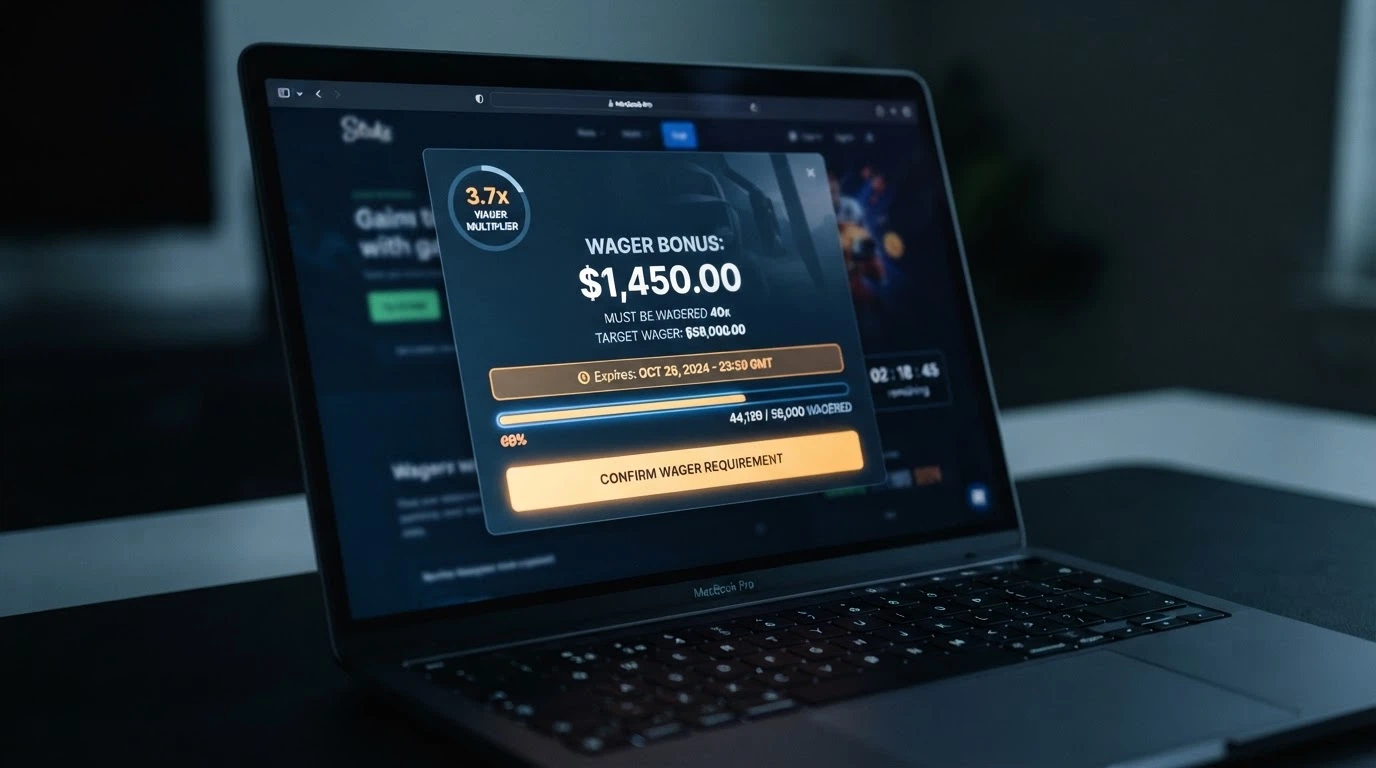
The expected cost of clearing a bonus is not the bonus itself. Running 200 BTC in turnover at a representative slot RTP of 96.47% — Pragmatic Play’s portfolio average, and a reasonable proxy for the kind of pokies most players will run during wagering clearance — gives an expected loss of roughly 7 BTC on a 5 BTC bonus. The maths is straightforward: turnover × (1 − RTP), where (1 − 0.9647) ≈ 0.0353. That is the average the house keeps across many spins, not a guaranteed loss for any individual session. A player who hits a 21,175× max-win round on Sweet Bonanza during clearance sees a completely different outcome; a player who grinds the wagering through without a major hit sees something close to the expected figure. The “bonus” is real money the house is lending the player to play with, and the wagering obligation is the price of borrowing it. The headline is the ceiling; the expected loss is the floor of what it costs the average player.
The comparison that matters: average crypto welcome match sits at 150% up to A$3,000 with 35× bonus wagering and 100 free spins attached; the fiat equivalent averages 100% up to A$1,500 with 40× wagering and 50 free spins. Crypto bonuses are larger on the headline and lighter on the wagering — that is the category’s structural edge. Wager-free offers exist (Winz.io runs 0× across all rewards; Goldenbet cash gifts are zero-wagering; Jack.com uses 30× bonus-only) but they are rare and largely absent from this featured set. Cloudbet’s rakeback is the closest analogue in this ranking: the welcome is a real-cash payout on house edge, not a bonus with a wagering target.
Welcome Bonuses: The Big Numbers and the Fine Print
The wagering column above carries the headline multiple. The validity window is what decides whether a player can actually clear it. Seven-day windows are tight: a player clearing 200 BTC in turnover at A$5 per spin runs 40,000 spins, which at roughly five seconds per spin is around fifty-five hours of continuous play. A fourteen-day window gives breathing room; a thirty-day window is the only structure that lets a casual player clear the bonus without grinding. Game contribution rates matter: slots contribute 100% at most operators in this set, but table games and live dealer typically contribute 5% to 10%, which means a player who likes blackjack needs to run ten to twenty times the wagering volume for the same clearance. Max-bet-while-clearing caps — A$5 at BitStarz, A$10 at FortuneJack — are the rule that voids a bonus if broken, and most operators enforce it automatically.
| Operator | Wagering Requirement | Bonus Validity |
|---|---|---|
| Cloudbet | 0× (rakeback model) | 30 days |
| BitStarz | 40× bonus only | 7 days (bonus); 1 day (FS) |
| BC.Game | 40× bonus | 14 days |
| FortuneJack | 10× per mission (deposit amount); 30× default rollover | 7 days default |
| KatsuBet | 40× bonus (45× high-roller) | 7 days (bonus); 3 days (FS) |
| Stake | N/A (rakeback model) | N/A |
| Rainbet | — | — |
| Wild Tokyo | 35× bonus | — |
| 7Bit Casino | 45× bonus | — |
| Bets.io | 40× (deposit + bonus) | — |
The dashes in the table mark where research did not return a publicly confirmed figure for that operator this run. The wagering column shows the structural difference between the bonus-only and deposit-plus-bonus models — at 40× bonus-only on a 5 BTC bonus, the turnover target is 200 BTC; at 40× on deposit plus bonus at Bets.io, the same nominal bonus implies roughly double the volume. Validity windows follow a similar pattern: where research confirmed a window, the seven-day default is the most common shape.
No-Deposit Bonuses: Free Bitcoin With Strings Attached
A no-deposit bonus (NDB) lets a player test the cashier and the bonus flow without committing funds first. In the Australian-facing market the typical NDB sits in the 0.0001 to 0.001 BTC range — roughly A$5 to A$50 at current rates — with most landing around 0.0003 BTC or a stablecoin equivalent. The strings are consistent: 35× to 60× wagering on winnings only (not on the bonus itself), a withdrawal cap of 0.005 to 0.01 BTC, and an expiry of twenty-four hours to seven days. The combination is harsh. A 0.0003 BTC NDB at 45× wagering with a 0.01 BTC cashout cap turns a free trial into a forty-five-times-turnover grind against a withdrawal ceiling the player is unlikely to reach.
Three operators in this set have publicly documented NDB terms. BitStarz: 40× wagering on winnings, A$100 maximum cashout, seven-day expiry. KatsuBet: 30× on winnings, A$100 maximum cashout, seven days. 7Bit Casino: 45× on winnings, A$100 maximum cashout, seven days. The A$100 cap is the real limit — a player who runs the wagering and hits anything meaningful still cannot withdraw more than A$100 from the bonus-derived balance. The NDB is a free test of the cashier and the game library, not a path to a payout.
Wager-Free and Rakeback Deals: When You Actually Keep What You Win
The wagering maths disappears entirely on a wager-free deal. Winz.io runs 0× across all rewards; Goldenbet cash gifts have zero wagering; Jack.com uses bonus-only wagering at 30×. None of these operators is in this featured set, but the category exists in the broader market, and the gap is worth knowing. Cloudbet’s rakeback is the closest analogue in this ranking — ten per cent of the house edge on every bet, paid daily, in withdrawable cash, with no turnover requirement. Stake’s model is the same shape at the operator level — rakeback across the active player base rather than a welcome package — and the difference is structural: the player earns from playing rather than from depositing.
Most operators in this set do not offer wager-free deals because the maths does not work for the house. A 100% match at 0× wagering means every bonus-derived dollar is withdrawable immediately, and bonus abuse becomes the dominant player behaviour. The rakeback model sidesteps the problem by tying the payout to house edge rather than to deposit size — the player earns based on play, not on how much they put in. For a player who treats gambling as entertainment rather than a bonus-clearing project, rakeback is the cleaner value proposition. For a player who wants the biggest one-time welcome number, the deposit-match bonus is the bigger headline but the smaller expected return.
The Bitcoin Pokies Where the RTP Actually Works in Your Favour
RTP — return to player — is the long-run theoretical payback of a pokie, expressed as a percentage of stakes wagered. A 96.50% RTP game returns A$96.50 for every A$100 wagered across millions of spins; the house keeps the other A$3.50. The published RTP on a game’s information page is the maximum the provider allows. The actual RTP the player faces is whatever the operator configures — and many operators run games at a setting below the published maximum. Book of Dead (Play’n GO) runs at five different RTP settings, ranging from 96.21% at the top end down to 84.18% at the bottom; the same title at two different casinos can sit twelve percentage points apart in theoretical return. That is the gap between a game that is “good value” and one that is structurally bad.
Provider averages give a faster read. NetEnt runs the highest portfolio average at 97.50%, anchored by Mega Joker (up to 99%) and Blood Suckers (98%) — both outliers rather than typical NetEnt releases. BGaming sits at 97.00% portfolio average and was the first provider to build provably fair verification into its games, so every spin’s RNG is independently checkable. Pragmatic Play averages 96.47% across its portfolio, above the fiat-industry average of around 95.5%, and is the most popular pokies provider in Australia in 2026, releasing up to six new games per month. Nolimit City sits at 96.05% portfolio average across ninety-plus titles, with extreme max-win ceilings — Super Sized at 150,000×, Fire in the Hole xBomb at 50,000×, and a 300,000× stake potential on its high-roller titles. The provider on the loading screen matters more than most punters assume.
The Highest-RTP Bitcoin Pokies Worth Your Spins
The table below carries the six titles with independently verified RTPs from research, with the volatility and max-win figures research supplies. Titles without a confirmed volatility or max win from research take a dash in that column. The operator-configured RTP caveat above applies to every row — the published figure is the ceiling, not the guarantee.
| Slot Title | RTP | Provider | Volatility | Max Win |
|---|---|---|---|---|
| Mega Joker | Up to 99% | NetEnt | — | — |
| Blood Suckers | 98% | NetEnt | — | — |
| Elvis Frog in Vegas | 96.79% | BGaming | High | 5,000× |
| Sweet Bonanza | 96.51% | Pragmatic Play | High | 21,175× |
| Gates of Olympus | 96.50% | Pragmatic Play | High | 5,000× |
| Book of Dead | 96.21% | Play’n GO | High | 5,000× |
The two NetEnt titles at the top are the structural outliers. A 99% theoretical return on Mega Joker is closer to a table-game edge than a pokie edge; Blood Suckers at 98% sits in the same band. These are old games, with simpler mechanics and smaller max wins, and most modern players skip past them. The three 96%-cluster Pragmatic Play and BGaming titles — Elvis Frog in Vegas, Sweet Bonanza, Gates of Olympus — are the more typical high-RTP, high-volatility experience. Sweet Bonanza’s 21,175× max win is the standout number in the set; Book of Dead at 96.21% sits at the lower end of the high-RTP group and is also the title where the operator-configuration gap is widest.
Classic Reels, Video Slots, and the Providers Building Bitcoin Pokies in 2026
The studios on the loading screen determine the structural quality of the game more than the theme does. Pragmatic Play is the volume leader in Australia in 2026 — releasing up to six new games a month, with a portfolio average of 96.47% that sits above the fiat-industry baseline. BGaming’s contribution is the provably fair integration: the first provider to ship it, and the one whose top 2026 titles (Golden Avalon, Rocket Eruption, Merge Up at 97.25% RTP) anchor the higher end of the average-RTP table. NetEnt’s InfiniReels mechanic and its 97.50% portfolio average keep it in the structural tier above the Pragmatic and Nolimit ranges. Nolimit City sits at 96.05% portfolio average but pushes the upper edge of volatility harder than anyone else — max-win ceilings of 150,000× to 300,000× stake on its high-roller titles make it the studio of choice for a player who wants the long-shot payout rather than the steady drip.
Classic reels versus video slots is a meaningful split at the lobby level. Classic reels — three or five reels, fewer paylines, simpler bonus rounds — typically run at higher RTPs because the feature set is thinner. Video slots push the volatility higher and carry more complex bonus mechanics, which is where most of the high-max-win titles sit. For a player clearing a bonus, the higher the RTP and the lower the volatility, the faster the wagering moves — but the trade-off is a smaller ceiling on what a single spin can return.
What Crypto Casinos Do That Regular Online Casinos Can’t
Three features distinguish a crypto casino from any fiat online casino. Provably fair verification lets the player confirm that each spin was generated randomly and not retroactively altered by the operator — BGaming pioneered the integration, and operators like Stake run provably fair versions of their in-house titles. Blockchain-verifiable transactions mean every deposit and withdrawal sits on a public ledger the player can inspect. Self-custody between sessions means the player holds the wallet keys, and an operator that vanishes overnight does not necessarily take the bankroll with it — though any unwithdrawn balance is still gone.
The trade-off is the regulatory perimeter. Provably fair proves the spin was random. It does not prove the operator will pay the withdrawal. Blockchain verification proves the deposit cleared. It does not prove the operator holds the licence it claims or the licence will hold up if the player needs to escalate a dispute. Self-custody protects the wallet between sessions. It does not protect the balance sitting in the casino’s internal ledger. The crypto-native features are real and the regulatory gap is real, and the two sit on either side of the same coin.
Provably Fair Gaming: How It Works and Whether You Should Trust It
Provably fair is a verification system that lets the player check that each spin, hand or roll was generated by the operator’s random number generator before the bet was placed and was not altered afterwards. The mechanism runs on three inputs: a server seed generated by the operator, a client seed chosen by the player (or auto-generated by the casino), and a nonce that increments with each bet. The operator publishes a hash of the server seed before the bet, so it cannot change the seed after seeing the player’s choice; the player can verify the hash matches the seed after the bet resolves. BGaming was the first provider to build this into its game engine; every spin on a BGaming provably fair title is independently verifiable. Stake Originals — the in-house titles on Stake.com — use the same model.
The limit of provably fair is the limit of what it proves. It confirms the spin was random and not manipulated. It does not confirm the operator will honour a withdrawal request, will not void a winning bet on a technicality, will not disappear overnight, or will respond to a complaint. For a player who understands both halves of the system — provably fair on the game side, operator reputation on the payout side — the technology is genuinely useful. Treating “provably fair” as a substitute for regulation is a common mistake; it does not replace traditional regulatory oversight or guarantee honest operator behaviour.
No-KYC Casinos: Privacy vs the Safety Net You Give Up
Know Your Customer (KYC) verification is the process by which an operator confirms a player’s identity — typically a passport or driver’s licence, a proof of address, and sometimes a source-of-funds check. Australian-licensed wagering operators are required to run KYC under AUSTRAC’s anti-money-laundering regime; offshore crypto casinos are not, and the verification depth varies wildly across this set. Stake asks for an email and an Australian phone number at signup. Cloudbet triggers KYC at roughly US$2,200 in cumulative withdrawals. BitStarz triggers on withdrawal above a threshold. Some operators in the broader market ask for nothing at all until a withdrawal dispute arises.
The upside of low-KYC is real: faster signup, no document uploads, privacy from a data breach that exposes the player’s identity to other operators or to the open internet. The downside is the safety net that goes with it. KYC is what links a player to a complaint body — if an Australian-licensed operator refuses a withdrawal, the player escalates to the regulator, which has the power and the documentation to act. At an offshore casino with no KYC, the regulator is whichever Curaçao or Anjouan body issued the licence, and the documentation trail is whatever the player happened to provide during signup. BetStop does not apply — the National Self-Exclusion Register binds Australian-licensed services only, and an offshore casino keeps taking a self-excluded person’s money. The privacy-versus-protection trade-off is real, and the page’s position is that a player who values both should pick an operator with a tested withdrawal record and understand what recourse they actually have before depositing.
How Fast Your Bitcoin Withdrawal Really Arrives — and What Slows It Down
The fastest tested payout in this set was BC.Game at 3 minutes 47 seconds on a Saturday morning — a real transaction against the Bitcoin mainnet, settled to a wallet. Cloudbet followed at 4 minutes 11 seconds. Stake averaged 8 minutes 22 seconds. KatsuBet sat at 11 minutes 6 seconds. The gap between fastest and slowest across the four operators with published tested times is roughly three times, and none of the four took more than fifteen minutes for a returning customer.
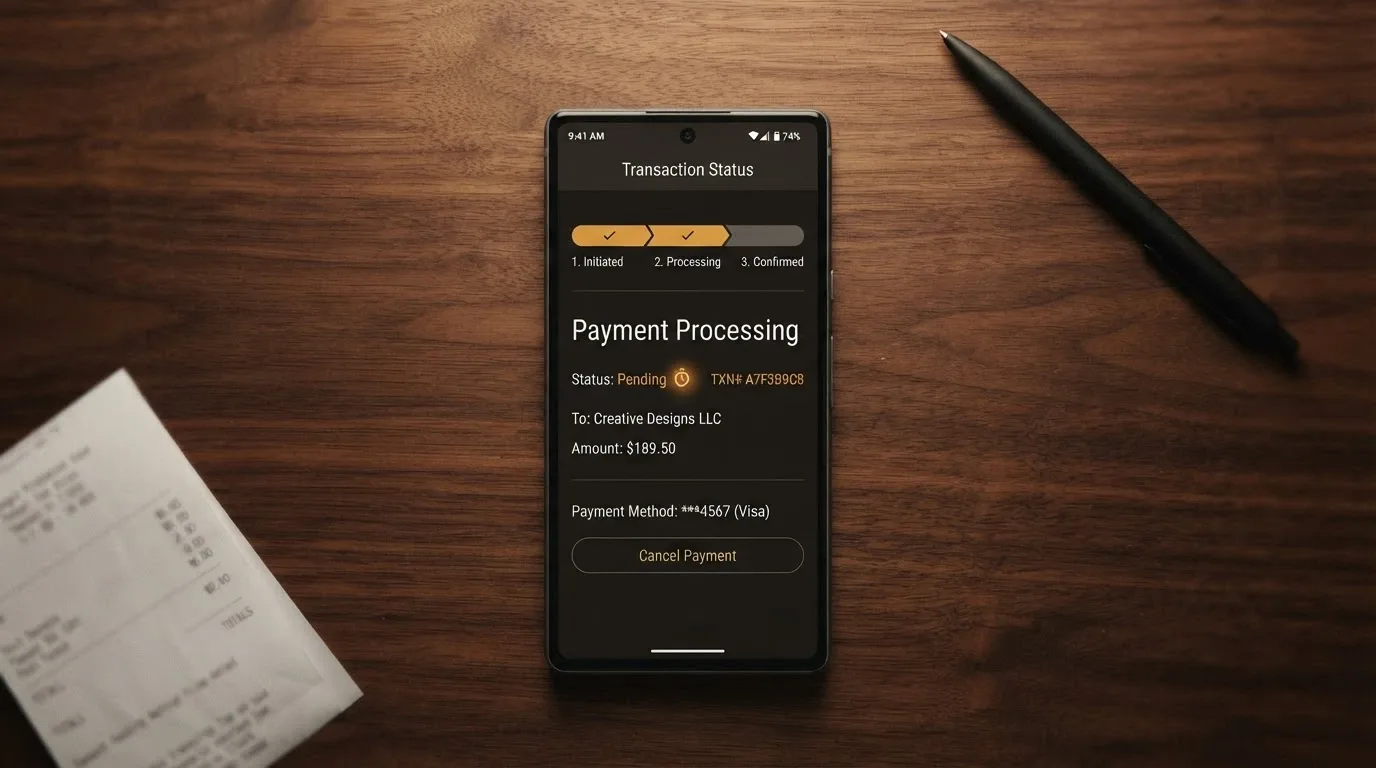
That number is for the fast case. The slow case is different. First withdrawals routinely take 24 to 72 hours — KYC verification, source-of-funds checks, and manual review pad the first cashout even at the fastest operators in the set. Subsequent withdrawals at the same operator clear faster, but the first one is the test of whether the cashier actually works. Typical processing windows across this set: BC.Game 5 to 15 minutes, BitStarz 8 to 11 minutes, Stake 0 to 1 hour, Rainbet within 24 hours (often minutes). The operator’s “processing time” is the queue inside the casino; the “blockchain confirmation time” is the wait after the casino broadcasts the transaction. The player sees both stacked.
What slows a withdrawal: first-time verification (the largest single delay), manual review triggered by unusual patterns, Bitcoin mempool congestion (the chain gets busy when the price moves and miner fees rise), weekend vs weekday (some operators run smaller review teams on weekends), and the network itself. Bitcoin mainnet settles in roughly ten minutes in normal conditions; USD on Tether via Tron or USDC on Solana settles in under a minute; Ethereum mainnet sits at twelve seconds to a few minutes. The Lightning Network pushes the floor further — a thirty-day pilot processed 237,000 payments at a 99.94% success rate and an average settlement of 1.86 seconds — though not every operator in this set supports Lightning withdrawals yet.
Depositing Bitcoin: Confirmations, Lightning, and What Your Screen Shows
A bitcoin deposit is not instant, even though the marketing copy says it is. The flow runs in five steps: the casino generates a unique deposit address, the player sends BTC from their wallet to that address, the transaction enters the mempool (the queue of unconfirmed transactions on the Bitcoin network), miners include it in a block, and the casino credits the player’s balance after a set number of confirmations. Most operators credit after one to three confirmations — typically 10 to 30 minutes total depending on network congestion. The player sees the balance appear in their casino account once the confirmations land.
Lightning deposits are the near-instant alternative. The Lightning Network runs on top of Bitcoin’s base layer and settles payments in seconds rather than minutes; the pilot data — 237,000 payments in thirty days at 99.94% success — is the cleanest performance benchmark available. The operator-side support for Lightning is uneven: some casinos in this set support Lightning deposits, others do not. For a player whose priority is deposit speed, USDT on Tron or USDC on Solana both settle in under a minute and are the fastest rails in this category, with BTC mainnet roughly ten times slower and Lightning up to two hundred times faster than BTC mainnet in the right conditions.
Minimum deposit amounts cluster low across the set. Cloudbet accepts 0.001 BTC (~A$10). BitStarz and Stake both accept 0.0001 BTC (a few dollars). The casino does not charge a deposit fee — the player pays the blockchain miner fee, which shifts with network congestion — and the operator’s incentive is to credit the deposit as fast as possible to get the player playing. The wait is on the blockchain side, not the operator side.
Withdrawal Speed Tested: Who Pays Fastest and What Can Delay You
The four tested withdrawal times from this set rank in this order: BC.Game at 3 minutes 47 seconds (the fastest, on a Saturday morning), Cloudbet at 4 minutes 11 seconds, Stake at 8 minutes 22 seconds, KatsuBet at 11 minutes 6 seconds. The data comes from independent testing on BitcoinCasinoz with timestamps and transaction hashes, not from operator-published marketing. The slowest of the four — KatsuBet at just over eleven minutes — is still faster than any fiat withdrawal path through an Australian bank.
The first withdrawal is the test that matters. KYC verification, source-of-funds checks, and manual review pad the first cashout to 24 to 72 hours even at the fastest operators; subsequent withdrawals at the same operator clear much faster. The casino’s published “processing time” and the blockchain’s “confirmation time” stack: the operator’s queue plus the network’s confirmation. For a player who wants a fast first withdrawal, the only honest signal is a third-party test, not the operator’s published “instant withdrawals” claim — which is true for the second withdrawal, not the first.
What to do when a withdrawal stalls: check the operator’s stated processing window first (most publish it), then check the blockchain confirmation count on the transaction hash (the operator will usually provide one), and if neither explains the delay, contact the operator’s support. The recourse beyond support is the operator’s licensing body — Curaçao GCB or the Anjouan regulator — and the operator’s track record on third-party review sites. None of that is fast, none of that has the weight of an Australian regulator, and none of that is a substitute for an Australian-licensed operator.
Bitcoin Casino on Your Phone: What Mobile Play Looks Like in 2026
Most bitcoin casinos run in a mobile browser rather than a dedicated app. The reason is partly the App Store and Google Play restrictions on real-money gambling apps in Australia, and partly the cross-platform practicality for an offshore operator serving multiple jurisdictions. The experience ranges from polished — BitStarz, BC.Game, and Stake have mobile-optimised sites that mirror the desktop lobby cleanly — to barely functional, with game lobbies that do not load cleanly on smaller screens and live dealer streams that buffer on cellular connections.
What a player should check before depositing on a phone: whether the lobby loads cleanly without horizontal scrolling, whether the cashier is fully functional on mobile (some operators strip the cashier down to deposits only on mobile and require desktop for withdrawals), whether the live dealer stream runs at a usable resolution on cellular, and whether the wallet integration works in a mobile browser extension or requires a separate wallet app. For an Australian player using a mobile browser, the practical experience is close enough to desktop that the device is rarely the limiting factor — the network is, especially for live dealer tables. The operators in this set do not publish detailed mobile-app audit data, which is the gap to know about if mobile is the primary play environment.
Live Dealer Tables With Bitcoin: Blackjack, Roulette, and the Real Casino Feel
A live dealer table is a streamed game with a real croupier dealing cards or spinning a wheel from a studio, with players placing bets through the casino interface and the dealer responding in real time. The format is the closest thing to a casino floor without leaving home — physical cards, physical wheel, human dealer, real-time decisions. Bitcoin and the major altcoins settle against the live balance the same way they settle against any other game on the platform. The major studios powering live dealer in this set are Evolution (the dominant provider across BitStarz, BC.Game, Stake, Rainbet, KatsuBet) and Pragmatic Play Live (running alongside Evolution at several operators in the set).
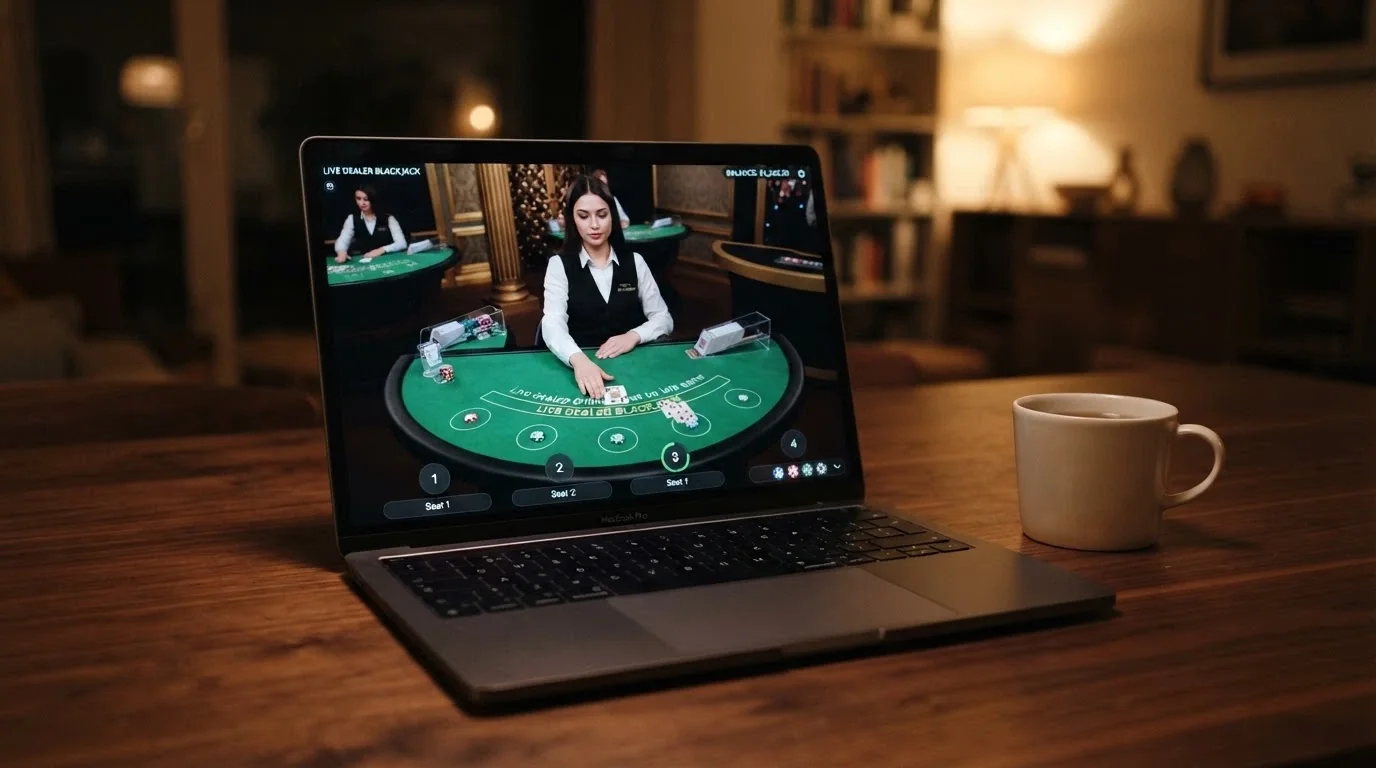
The two dominant formats are live blackjack and live roulette. Live blackjack runs standard rules with side bets (Perfect Pairs, 21+3) attached; live roulette offers European (single-zero, lower house edge) and American (double-zero, higher house edge) wheels. Game-show titles like Crazy Time and Monopoly Live sit alongside the core tables at most operators and add wheel-of-fortune mechanics with multiplied payouts. The RTP difference between live dealer and slots is meaningful: live blackjack at standard rules sits around 99.5% with optimal play, European roulette at 97.3%, American roulette at 94.7% — all higher than the typical pokie, but the bonus-contribution gap closes most of that advantage during wagering clearance.
Live Blackjack and Live Roulette: The Two Tables Bitcoin Players Actually Use
Live blackjack at a bitcoin casino runs the same as live blackjack anywhere else: eight decks, dealer stands on 17, player can double after split, and side bets layered on top. The crypto balance displays in the corner of the table interface; the player bets in fiat equivalent and the casino converts at the cashier’s spot rate. Table limits vary by operator — minimum bets from A$1 to A$5 at the low end, maximums in the thousands at the high-roller tables. Live roulette runs European (single zero, house edge 2.7%) and American (double zero, house edge 5.26%) variants, with the European wheel the better value for a player who has the choice.
Game-show titles — Crazy Time, Monopoly Live, Deal or No Deal — sit in the live dealer lobby at most operators in this set. The RTP varies widely; some game-show titles run below 95%, which makes them the wrong place to clear a wagering requirement. Bonus clearance is most efficient at live blackjack tables due to optimal strategy; however, those primarily interested in the entertainment value of live dealer games should expect the immersive experience to be the core attraction.
RNG vs Live Dealer: The Difference That Changes Your Odds — and Your Bonus
RNG (random number generator) table games run on the same engine as the pokies — a software RNG determines each card or spin, and the game runs at the speed of the player’s clicks. Live dealer runs on a physical deck or wheel with a human dealer, streamed to the player. The math is the same on paper; the experience is different in practice. RNG tables play faster (no waiting on the dealer), allow lower minimum bets, and run without a stream buffering over a patchy mobile connection. Live dealer is slower but carries the casino-floor feel that RNG cannot replicate.
The bonus-contribution gap is what changes the wagering maths. Slots contribute 100% to wagering at most operators in this set. RNG table games typically contribute 10% to 20%. Live dealer games typically contribute 5% to 10%. The lower contribution reflects the lower house edge on live tables — the operator makes less margin on live blackjack at optimal play than on a 96% pokie, so the bonus contribution is set lower to reflect that. For a player clearing a bonus, the contribution rate means that running 200 BTC in turnover at slots requires 200 BTC in slot bets, while running the same clearance at live dealer would require 2,000 to 4,000 BTC in live dealer bets. The math is the same; the time is much longer.
The Legal Reality: Every Bitcoin Casino Australians Use Is Offshore
The Interactive Gambling Act 2001 prohibits online casino games, online pokies, and in-play sports betting as services provided to people in Australia. The Act is enforced against the provider, not the player — providing a prohibited interactive gambling service to customers in Australia is the offence, and the Australian Communications and Media Authority (ACMA) is the body that investigates, issues formal warnings, and refers operators for civil penalty proceedings. The ACMA has directed Australian ISPs to block 1,564 illegal gambling and affiliate websites since November 2019, and more than 225 illegal services have withdrawn from the Australian market since 2017. The site that a player can reach today may be on the blocked list tomorrow, and the ACMA does not compensate balances that sit in the casino at the moment of blocking.
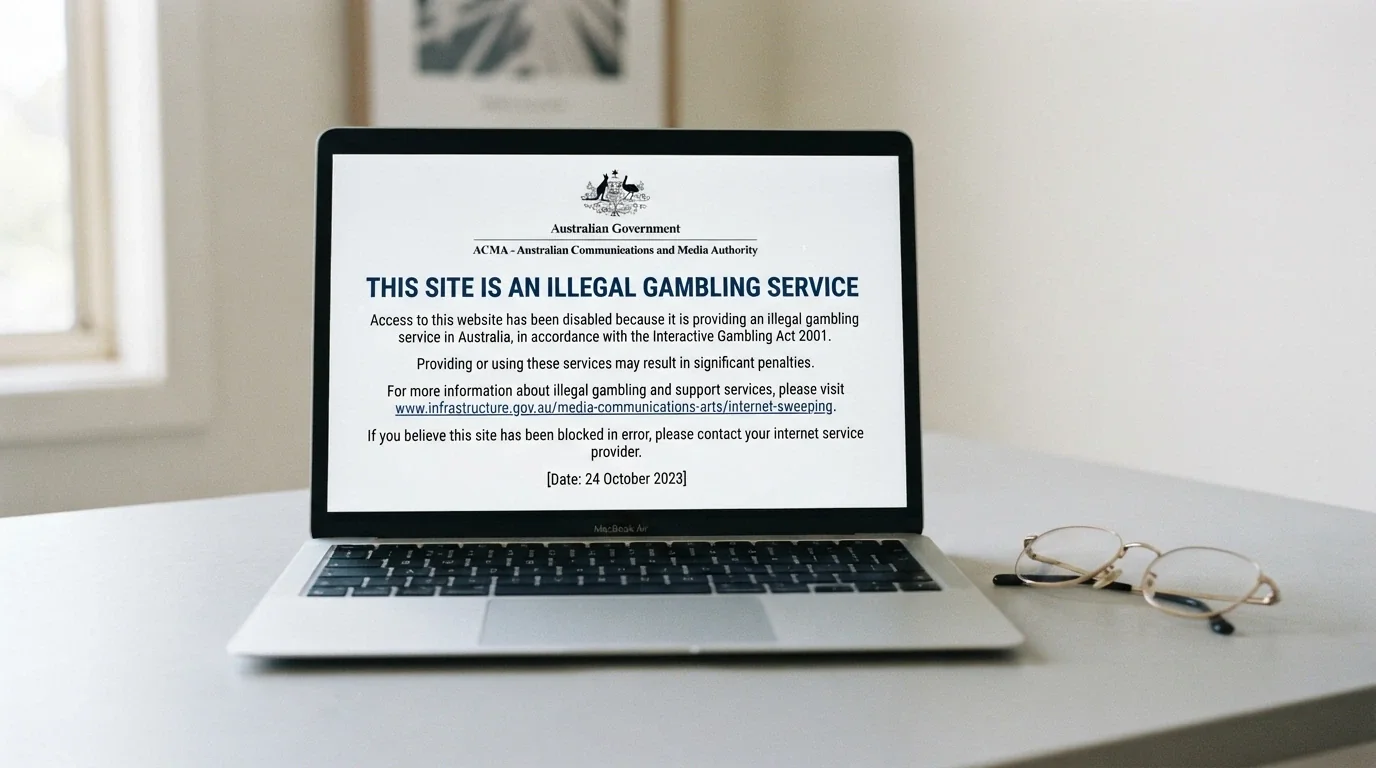
The credit-card and crypto payment ban commenced on 11 June 2024 under the Interactive Gambling Amendment (Credit and Other Measures) Act 2023. Credit cards, credit-related products, and digital currency (crypto) are banned as payment for online wagering in Australia — a category that covers licensed sports and racing wagering as well as the offshore casino product. The penalty for an operator that fails to enforce the ban is up to A$247,500. The practical effect for a player is that no Australian-licensed operator accepts bitcoin deposits, which is part of why the offshore crypto casino market exists in the shape it does — the licensed market is structurally closed to crypto even for the products it is allowed to offer.
The individual player is not prosecuted under the IGA. The Act targets the provider. That distinction is real, and it is also narrower than most players assume — “not prosecuted” is not “protected”. A player at an offshore casino has no Australian consumer-protection law to fall back on, no Australian regulator to escalate a complaint to, no BetStop coverage, and no recourse if the operator refuses a withdrawal or voids a winning bet on a technicality. The IGA’s protection is the absence of the product domestically; the player’s exposure is the absence of protection offshore.
The Interactive Gambling Act: What It Actually Prohibits — and What It Doesn’t
Three interactive gambling services are prohibited to people in Australia: online casino games (blackjack, roulette, baccarat, poker), online pokies (slots), and in-play sports betting (betting on a sporting event once it has started). What is permitted and licensable: wagering on races and sporting events placed before the event begins, lotteries, and keno — operated under state and territory licences. The Northern Territory, through Licensing NT (formerly the Northern Territory Racing and Wagering Commission), is the de facto national licensor for online wagering; the large online bookmakers — Sportsbet, bet365, Ladbrokes — hold NT licences with terms of up to twenty years. The NT regime was reformed in 2026. The minimum age for all commercial gambling in Australia is 18.
The Interactive Gambling Amendment (Gambling Reform) Bill 2026 passed Parliament on 19 August 2026; its measures commence on 1 January 2027. From that date, no more than three wagering advertisements per hour between 6:00 am and 8:30 pm, and no wagering advertising from fifteen minutes before a live sporting event until five minutes after it ends. Banks and payment providers gain express authority to block transactions to illegal gambling operators. Inducements (sign-up offers, referral bonuses) become prohibited for fourteen days after sign-up, three months after BetStop deregistration, and indefinitely for at-risk customers. The 2027 rules are law, with a start date — they are not proposals and not speculation.
Offshore vs Licensed: What Australian Players Actually Give Up
Playing at an offshore bitcoin casino costs the player every layer of Australian consumer protection. There is no Australian Consumer Law recourse — the ACL does not apply to an operator outside the jurisdiction. There is no BetStop coverage — the National Self-Exclusion Register binds Australian-licensed services only, and an offshore casino is not connected, so a self-excluded player keeps depositing and wagering at any offshore casino they can reach. There is no ACMA complaints mechanism for a refused withdrawal — the ACMA can investigate and block illegal services, but it cannot recover a player’s money from an offshore operator that refuses to pay.
The site itself can be blocked at any time with a balance on it. The ACMA’s 1,564-site blocking record since 2019 is the clearest evidence of how aggressively the regulator moves against offshore operators; a bitcoin casino reachable today may be on the blocked list tomorrow, and the player’s balance in the casino at that moment is unrecoverable through any Australian channel. There is no AUSTRAC AML oversight of the offshore operator. There is no state or territory gambling regulator to escalate a dispute to. The player relies entirely on the operator’s goodwill, its reputation offshore, and the third-party review sites that have tested its withdrawal reliability.
From 1 January 2027, banks and payment providers gain express authority to block transactions to illegal gambling operators. The credit-card and crypto payment ban from 2024 already cuts off one payment rail; the 2027 change widens the authority to banks and payment processors more broadly, making it easier for an Australian bank to decline or delay a transaction bound for an offshore casino. The direction of travel is toward more friction for the offshore market, not less.
Playing Safely: Where to Get Help When Gambling Stops Being Fun
About 2.1% of Australian adults — roughly 430,000 people — experience problem gambling, and the Australian Institute of Health and Welfare put high-risk gambling at 1.8% in 2022. Australia carries one of the highest problem-gambling rates in the developed world, and the offshore crypto market — which sits outside every Australian protection regime — is the part of the market with the fewest guardrails. The tools exist for a player who needs them. They do not always reach the offshore market.
The National Gambling Helpline is 1800 858 858 — free, confidential, staffed twenty-four hours a day, seven days a week. Gambling Help Online runs 24/7 online chat and email counselling through gamblinghelponline.org.au. BetStop — the National Self-Exclusion Register — had 67,480 registrations as at 31 July 2026, with 41,290 exclusions still active (more than sixty per cent of total registrations). 78% of registrants were under 40, and 38% chose lifetime exclusion. One BetStop registration excludes a person from every Australian-licensed online and phone wagering service. The critical limit of BetStop is that it binds only Australian-licensed services — an offshore casino is not connected, and will keep taking a self-excluded person’s money. Registering with BetStop is a critical step, but offshore casinos remain outside this safety net, leaving players to manage these risks independently.
Deposit Limits, Reality Checks, and the Tools Offshore Casinos Do — and Don’t — Offer
Australian-licensed wagering operators must offer deposit limits, activity statements, take-a-break periods, and self-exclusion. These are regulatory requirements, not voluntary features. Offshore casinos are not obliged to offer any of them, and the depth of responsible-gambling tools in this set varies. Some operators run voluntary deposit limits and session reminders; others carry a responsible-gambling page with the helpline number and nothing else. The gap between a regulated tool and a marketing checkbox is the difference between a limit the operator enforces and a limit the player enforces on themselves.
For a player at an offshore casino, the practical harm-minimisation moves are the player’s own. Set a hard deposit ceiling before the first deposit and stick to it. Withdraw winnings early and often rather than letting a balance accumulate in the casino’s internal ledger — the balance sitting in the casino is the balance that disappears if the site gets blocked. Keep gambling spend in a separate budget line that does not touch rent, bills, or savings. Read the bonus terms before claiming any offer — a 40× wagering requirement is the difference between a free trial and a fifty-hour grind. Use BetStop for the licensed market and understand that it does not cover the offshore casinos on this page. If gambling stops being fun, the helpline is 1800 858 858 — free, confidential, twenty-four hours a day.
What Separates a Trusted Bitcoin Casino From Everything Else
A crypto casino can carry a polished lobby, a multi-thousand-game library, and a Curacao or Anjouan licence and still be one ACMA blocking action away from vanishing overnight. The evaluation that matters is not the bonus headline — it is the licence verifiability, the withdrawal track record, the bonus-term fairness, and the provider quality on the games. A licence from Curaçao GCB with a published registration number (Cloudbet’s OGL/2024/328/0599 is the clearest example in this set) is verifiable on the regulator’s public register; an Anjouan licence through RBGAMING N.V. is verifiable through Anjouan’s registry; a claimed licence without a registration number is a marketing line, not a credential. The test is whether the player can check the licence independently, not whether the operator says one is held.
The withdrawal track record is the harder signal. Tested payout times from independent third parties (BitcoinCasinoz, RushLayer) carry more weight than operator-published “instant withdrawals” claims, because the operator’s claim is for the second withdrawal, not the first — and the first withdrawal is the test that matters. A Safety Index score from Casino.Guru (Cloudbet at 9.2 is the highest in this set) is a third-party aggregation of complaint volumes, licensing standing, and withdrawal reliability, and it is the closest the offshore market comes to a public reputation score. Bonus-term fairness is the third signal: a 0× wagering rakeback model is structurally different from a 40× bonus-only deposit match, and the difference between them is the difference between a real-cash payout and a turnover grind. Game-provider quality — NetEnt, BGaming, Pragmatic Play, Nolimit City — signals a legitimate B2B relationship that the operator pays for; an unknown provider list suggests either an aggregator-only operation or a less rigorous integration.
The limit of any evaluation: no offshore casino offers the protections of an Australian-licensed service. The IGA prohibits the product domestically; the offshore market exists because the product is not offered at home. Every signal on this page — licence, track record, tested withdrawal, provider quality — reduces the risk that the offshore product disappoints; none of them eliminate the structural risk that the operator is outside the Australian regulatory perimeter.
The Criteria That Actually Matter When Comparing Bitcoin Casinos
Five criteria order this ranking: licence transparency and verifiability, bonus-term fairness, withdrawal speed and reliability, game-provider quality, and track record. Licence transparency means the operator publishes the regulator, the licence number, and the issuing company — and the licence can be confirmed on the regulator’s public register. Bonus-term fairness means the wagering multiple, the cashout cap, the validity window, the max-bet-while-clearing rule, and the game contribution rates are stated in plain language before the player deposits — not buried in a terms page the player has to find. Withdrawal speed and reliability means a third party has tested the payout and published the timestamp, not just the operator’s “instant withdrawals” claim.
Game-provider quality means the studio names are recognisable — Pragmatic Play, BGaming, NetEnt, Play’n GO, Nolimit City, Evolution — and the provider list is verifiable through the studios’ own integration pages. Track record means the operator has been running long enough to have a public complaint history, and that history is searchable on third-party sites like Casino.Guru, AskGamblers, and the Bitcoin casino review aggregators. These criteria are applied throughout the ranking on this page. They are not new and they are not invented for this list — they are the criteria the operator write-ups above already worked from, named here so the reader can apply them to any operator not on this list.
How We Evaluated Every Bitcoin Casino on This Page
The ranking on this page rests on four sources. The ACMA public register and the operator’s own licensing disclosure (Curaçao GCB or Anjouan registry) for licence status. Independent casino review databases — Casino.Guru for Safety Index scores, AskGamblers for complaint history — for third-party standing. Directly tested withdrawal times from BitcoinCasinoz (with timestamps and transaction hashes) and processing-window data from RushLayer, for the payout claims. Provider-published RTP data — Pragmatic Play, BGaming, NetEnt, Nolimit City, Play’n GO’s own game information pages — for the slot figures.
What the evaluation covers: licence transparency and verifiability, bonus-term fairness (wagering multiples, cashout caps, validity windows, max-bet-while-clearing rules), tested withdrawal speed at four of the ten featured operators, game-provider quality and catalogue breadth, track record and third-party safety scores.
What the evaluation does not cover: every operator’s full game catalogue has not been individually audited; every licence claim has not been verified against the regulator’s live database in this run; withdrawal reliability has not been tested over multiple attempts at every operator; the responsible-gambling pages of the featured operators have not been audited in detail; the per-operator mobile-app audit data is not available in this run. These limitations are stated plainly. The page is honest about what it does not cover because the reader’s decision depends on knowing both halves.
Before You Deposit a Single Satoshi: The Decision Every Australian Player Has to Make
A bitcoin casino gives an Australian player access to thousands of casino games right now — pokies, blackjack, roulette, live dealer — with deposits that clear in minutes and withdrawals that, in the best case, arrive in under four minutes. That access is real. It is also unregulated, offshore, and outside every consumer-protection system Australia has built for gambling. The Interactive Gambling Act prohibits the product domestically; the ACMA has blocked 1,564 sites since 2019; the credit-card and crypto payment ban from 2024 cuts off one payment rail; the 2027 reform gives banks and payment providers express authority to block transactions to illegal operators. The direction of travel is toward more friction for the offshore market, not less. A player using a bitcoin casino today is betting that the site stays reachable, stays solvent, stays honest, and stays unblocked for as long as the bankroll sits with them.
The bonus looks big until the wagering maths runs. A 5 BTC bonus with 40× wagering is a 200 BTC turnover obligation; at a representative slot RTP of 96.47%, the expected loss during clearance sits around 7 BTC. The bonus is real money the house lends the player to play with, and the wagering obligation is the price of borrowing it. The expected-loss calculation is an average across many spins, not a guaranteed outcome for any individual session — a player who hits a 21,175× max-win on Sweet Bonanza sees a completely different result — but it is the number a player should plan around.
The tested withdrawal speeds are real. BC.Game at 3 minutes 47 seconds, Cloudbet at 4 minutes 11 seconds, Stake at 8 minutes 22 seconds, KatsuBet at 11 minutes 6 seconds. The first withdrawal can stall for 72 hours. The site can be blocked at any time with a balance on it, and no Australian regulator will help recover it. BetStop does not cover the offshore market — the National Self-Exclusion Register binds licensed services only. The player who has registered with BetStop and then deposits at an offshore casino has found the gap the register does not close.
The practical checklist: verify the licence on the regulator’s public register before depositing — not just because the operator says one is held. Read the bonus terms before claiming any offer — wagering multiple, cashout cap, validity window, game contribution rates. Withdraw winnings early and often rather than letting a balance accumulate in the casino’s internal ledger. Never deposit more than the player can afford to lose to a site with no Australian consumer-protection backstop. Use the National Gambling Helpline (1800 858 858) or Gambling Help Online (gamblinghelponline.org.au) if gambling stops being fun.
The closing position: bitcoin casinos give Australian players access to a product the law prohibits domestically. That access is real, the bonuses are large, the withdrawal speeds are fast, and the games are extensive. The access is also unregulated, and the player bears every risk the regulation was designed to remove. The decision is the player’s. The information on this page is what the decision should weigh.
Frequently Asked Questions
Are bitcoin casino bonuses actually better than regular casino bonuses?
Larger on the headline and lighter on the wagering, on average. The category averages 150% up to A$3,000 with 35× bonus wagering and 100 free spins attached; fiat equivalents average 100% up to A$1,500 with 40× wagering and 50 free spins. The crypto edge is real on the structure, but a 40× bonus on a 5 BTC headline is still a 200 BTC turnover obligation at most operators in this set — the bonus only matters if the player can clear it inside the validity window.
Do bitcoin casinos require KYC (identity verification)?
It varies across the set and is generally lighter than Australian-licensed operators. Stake asks for an email and an Australian phone number at signup. Cloudbet triggers KYC at roughly US$2,200 in cumulative withdrawals. BitStarz triggers on withdrawal above a threshold. No operator in this set requires a passport upload at signup; all reserve the right to request documentation before a large withdrawal. BetStop does not apply to any of them.
Can I use other cryptocurrencies besides bitcoin at Australian online casinos?
Yes. Most operators in this set accept ten to one hundred additional cryptocurrencies. USDT on Tether via Tron and USDC on Solana both settle in under a minute and are the fastest rails in the category. Ethereum mainnet settles in twelve seconds to a few minutes. Bitcoin mainnet itself takes around ten minutes in normal conditions, longer when the mempool is busy. The Lightning Network settles in seconds and is the fastest rail available where the operator supports it.
What happens if an offshore bitcoin casino refuses to pay out my winnings?
The escalation path runs through the operator’s support first, then the operator’s licensing body — Curaçao GCB for most operators in this set, the Anjouan registry for FortuneJack and Rainbet. Neither is fast, neither has the weight of an Australian regulator, and neither can recover money the operator has already moved. ACMA cannot help — it can investigate and block illegal services, but it cannot compel a payout from an offshore operator. The practical protection is the operator’s reputation and the third-party review sites that track complaint history.
Is provably fair gaming actually fair?
Provably fair proves the spin was random and was not altered after the bet was placed. It does not prove the operator will pay the withdrawal, will not void a winning bet on a technicality, will not disappear overnight, or will respond to a complaint. BGaming pioneered the technology and runs it across its portfolio; Stake Originals use the same model. For a player who understands both halves of the system, provably fair is a genuine tool. For a player who treats it as a substitute for regulation, the technology is being asked to do work it was never designed to do.
What is the minimum bitcoin deposit at Australian crypto casinos?
It varies across the set and is generally low. Cloudbet accepts 0.001 BTC (~A$10 at current rates). BitStarz and Stake both accept 0.0001 BTC (a few dollars). The casino does not charge a deposit fee — the player pays the blockchain miner fee, which shifts with network congestion. No-deposit bonuses exist at three operators in this set — BitStarz, KatsuBet, and 7Bit — and carry A$100 maximum cashout caps with 30× to 45× wagering on winnings.
Created by the ”Bitcoin Casinos Australia” editorial team.